(The Conversation) — Adek Stein – a Holocaust survivor from Bialystok, Poland – looked anxiously about the room, struggling with the question he’d just been asked. As his eyes searched his small audience, it was clear he was nervous. That itself wasn’t new. But the interviewer had asked about sexual violence during the Holocaust, and Stein’s face seemed to betray a pain and worry he had lived with for years.
The USC Shoah Foundation, which filmed its interview with Stein at his home in Australia in 1995, tries to interview survivors one-on-one, without distraction. But that day, several young women, presumably members of Stein’s family, stayed in the room as he gave testimony – including his experiences as a forced laborer at the Treblinka extermination camp, where more than 900,000 Jews were murdered. Then it came time to talk about how some Germans had taken Jewish women, in his words, “to make fun.”
He stopped and looked at each of those present. Speaking to his interviewer, Stein said he did not want to go on, worried that the story was “too drastic” to recount “in front of these girls.” Stein’s interviewer told him to continue, but he changed the subject and moved on. That was it. Whatever more he knew about the fate of those women went untold.
Sexual violence and exploitation of women during the Holocaust, as well as LGBTQ+ people’s experiences, are some of the many topics that survivors have often struggled to discuss, even decades after the war. In many cases, it has taken years for even the broadest histories to emerge. As ever, what readers can learn about the past is limited by what witnesses were willing to say or write down, and what historians are willing to research.
Women’s lives and resistance at Treblinka
In work for my 2026 book, “Survival at Treblinka,” I came upon Stein’s testimony and many other hints and fragments of women’s lives in that Nazi extermination camp. What I found for this project is important, but I also came to realize it was just one example of wider issues in Holocaust history.
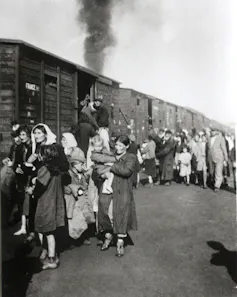
Polish Jews were deported to Treblinka extermination camp from the ghetto in Siedlce in 1942, when Poland was under German occupation.
Wikimedia Commons

Treblinka, located along the rail line northeast of Warsaw, was actually the name of two different camps. The first, Treblinka I, was one of Nazi Germany’s forced labor camps. Treblinka II, about a mile away, was an extermination camp. It had no function other than mass killing by poison gas and, because of this, never held much more than about 1,000 Jewish prisoners at a time.
SS guards and their helpers forced these inmates to maintain the camp, process goods stolen from those killed, and to bury – and later burn – the bodies. Women prisoners, never more than about 40 in number, were employed as launderers, cleaners, kitchen staff and tailors.
On Aug. 2, 1943, prisoners carried out a long-planned uprising, burning much of the camp. The revolt allowed as many as 300 Jews to escape – at least temporarily – although many were soon found and killed. In “Survival at Treblinka,” I uncover how Jewish women were pivotal to resistance planning, working as couriers, informants and to steal and hide weapons. They also took part in their own everyday acts of resistance, right up to the moment of the revolt.
At every turn, Jewish women and men held in this camp took advantage of the guards’ beliefs about women. Simply put, the German SS did not fear Jewish women, so guards did not supervise them or scrutinize them as much as they did male prisoners. Women cleaned the SS barracks and used these jobs to keep track of the Germans’ comings and goings. They staffed the kitchens and, using the fact that they were not feared, hid stolen weapons there.
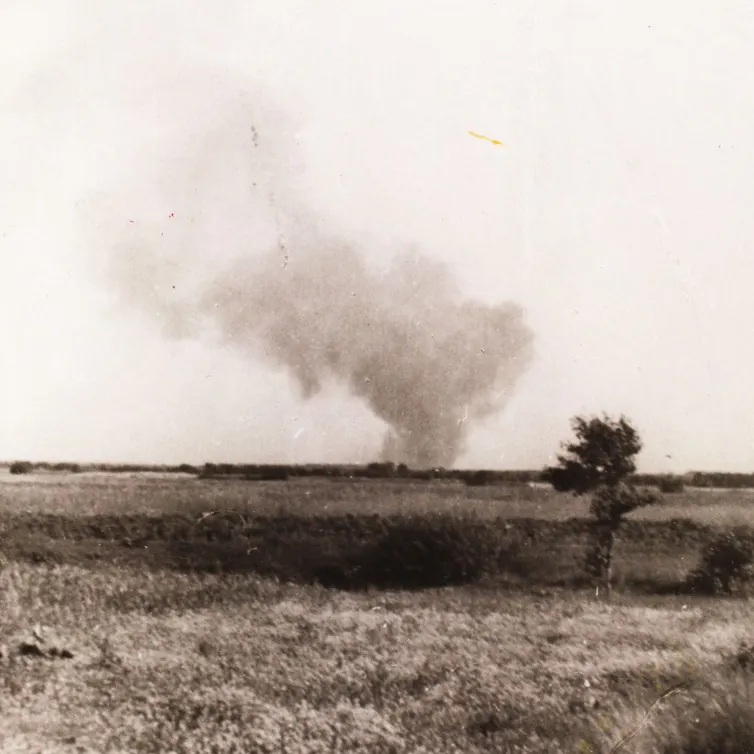
A clandestine photograph taken by Franciszek Ząbecki shows Treblinka II burning during the prisoner uprising on Aug. 2, 1943.
‘Treblinka II – Obóz zagłady’ via Wikimedia Commons
.jpg)
German guards created a camp brothel at Treblinka where certain guards and senior prisoners were allowed to assault Jewish women. Again, the Nazis did not fear or suspect those they compelled to endure that place. However, the women held there stole as many as eight rifles from guards to arm the revolt. That pivotal act of resistance and the entire existence of the brothel have not been discussed or remembered before my book.
Working in the 1970s, an earlier historian uncovered the same evidence of sexual exploitation and its outcomes at Treblinka, taken from trial investigation testimony evidence. He chose to cut that quote short and may not have had access to other testimony that proves the existence of a brothel.
As I show in “Survival at Treblinka,” not writing about the brothel also meant not speaking of how these women armed the uprising.
Silence and lost stories
The damaging silence of many male survivors on this topic is worsened by others’ decisions to deny or erase what happened, though that may be understandable. When that earlier historian wrote in the 1970s and ’80s, some of the women forced to endure that brothel were still living. Revealing what they had been through could have destroyed years of careful work to rebuild their lives and distance themselves from what was done to them in the wake of the Holocaust.
In one somewhat shocking example, a male survivor of Treblinka was asked during a 1996 interview by the USC Shoah Foundation whether he knew any women in the camp. That alone was a rare question in interviews between the 1970s and ’90s. The survivor’s answer, “There was no women,” was unequivocal – but not true.
Studying the prisoner revolt at Treblinka led Chad Gibbs to uncover more information about women’s experiences at the camp.
Maps show how male prisoners would have seen women in the camp several times a day, especially at mealtimes. If we plot the paths male workers would take to and from their jobs and account for their likely interactions with women in the kitchens, it is clear that all men had to know women were present at Treblinka.
Left to wonder why witnesses and writers tended to leave out these women and their stories, we must consider whether it was, at times, out of a need to preserve their own sense of masculinity – an unwillingness to discuss what they saw these women endure, which male prisoners could not stop. Of course, some survivors’ sense of culpability might run deeper if they participated in the abuse themselves.
Fearful and self-preserving silence, nervous and embarrassed avoidance, and even willful erasure kept stories like these in the dark. What we know of history is, again, a matter of what scholars and witnesses are ready to discuss, and what sources are prepared to write down, record or say aloud.
More than 80 years after the fact, these stories are coming to light just as many survivors are dying. That, I believe, is not entirely coincidental. As survivors leave us, the stories we tell and the questions we are comfortable asking of sources change. Historians’ own diversity today is also helping to bring attention to the lives of women, people with disabilities, the elderly, queer people and still other voices long obscured.
Distance from the event is sometimes what finally allows us the space to open new doors and hear new voices. That will certainly mean a reassessment and a broadening of Holocaust histories as time goes on. It is a process long overdue, for too much is lost when we look away.
(Chad S.A. Gibbs, Assistant Professor of Jewish Studies, College of Charleston. The views expressed in this commentary do not necessarily reflect those of Religion News Service.)

Original Source: